Monday, April 4, 2016

The 2016 election: Why it's so different


The 2016 election cycle in America has been unique, even by American standards. We are all witnessing the fascinating results of this unique political dynamic: a 74-year-old democratic socialist that is killing it with young voters, and a 69-year-old nationalist "billionaire" who poor and under-educated people trust to represent them the best in Washington.

Further, while Bernie Sanders and Donald Trump certainly have their differences, there are a few similarities that are so important to voters that, when in open primaries, many voters were deciding between these two candidates, regardless of party affiliation.

Since nobody paying attention could ever confuse Bernie with The Donald, this dynamic needs to be unpacked.

We've been led to believe that our two main national parties -- Democrats and Republicans -- create political platforms, and run and support candidates that they believe best represent their specific constituency of voters in the nation. In broad strokes, the Democrats have traditionally run on a platform of social liberalism and economic protectionism and the Republicans have run on social protectionism and economic liberalism.

These at-odds platforms, in theory, should cover most voters enough to suffice and ensure a representative governing body, right?

Wrong, of course.

In math class, I learned about something called combinatorics. It sounds fancy, but it's pretty straight-forward: it's a branch of mathematics focusing on countable discrete structures. In layman's terms, it's about figuring out how many variations can exist in a given system. Who would have thunk that combinatorics of all things can help us see what's missing in our mainstream political discourse?

Well, it can.

If we look at the existing two-party political system, we have, in broad strokes:
  • Economic liberalism & social protectionism (Republicans)
  • Economic protectionism & social liberalism (Democrats)
Based on a combinatorics calculation, the combination of 2 items in a group of size 2, there are 4 possible permutations**. As a result, there are 2 combinations that are not addressed by existing political containers:
  • Economic liberalism & social liberalism (Libertarians)
  • Economic protectionism & social protectionism (Populists)
** For the sake of brevity and focus, we can't explore all the 16 permutations there would be if "moderate" was added as a dimension for each political dimension.

Now, let's map these political systems to the remaining candidates in the race:
  • Hillary Clinton is, at heart, an 80's/90's Democrat, which is defined as a moderate economic liberal & social liberal ("Libertarian-lite"), but has been coerced (by Bernie's success) to run as an economic protectionist and social liberal -- a traditional Democrat.
  • Bernie Sanders is an economic protectionist & social liberal - placing him straight in the Democratic party camp.
  • Ted Cruz and John Kasich are economic liberals & social protectionists, placing both of them clearly in the Republicans camp.
  • Donald Trump is, at heart, a deal-maker with very little political "true north." However, as a practical matter, he is officially running as an economic protectionist & social protectionist -- a Populist. 
Looking at this mapping, we have some seriously bizarre dynamics at play: 
  • We have three distinct political systems in the race: Democrat, Populist and Republican. 
  • Both leading candidates -- Donald and Hillary -- are running on platforms that they aren't truly aligned with in their hearts, despite the fact that one of them is considered to be a "straight shooter." 
  • The leading candidates aren't a Democrat and a Republican; rather, they are an unwillfully coerced Democrat and a willfully-coerced Populist. 
  • Bernie, the self-described "Democratic Socialist" in the race, is actually running on a traditional Democratic platform, which shows you just how moderate mainstream Democrats have become since the 1980's, forced into moderation largely by the political tide of Reagan.
This helps explain what makes this race so unique: Officially, we have two parties running against each other, but in reality, we have three distinct parties competing with each other (and if Rand Paul were still in the race, then we'd have all four political combinatoric parties in the race!).

Trump and Sanders have become iconoclastic and share so many swing voters because they are both representing economic protectionism in their platforms. This tells us that there is a real hunger for economic protectionism, which, interestingly, is not where either the modern Democrat or Republican party is right now at the national level. This represents a crisis for the political elite who believe that long-term gain in free trade and unfettered capitalism outstrips the short-term pain. 

The Trump and Sanders parallel phenomenons point to the reality that our major national parties aren't offering up enough diversity to satiate a significant proportion of the electorate. Bernie and Trump are live-action lessons for a free democracy: Where there's a political itch, a candidate will eventually come along to scratch it. And if that candidate wins, it can bring the party with them.

Saturday, March 26, 2016

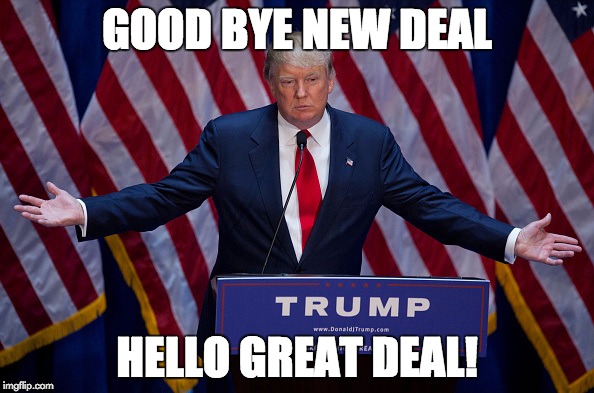
With Donald Trump, deal-making drives policy


In The Trump Diagnostic, I determined that deal-making is at the core of Donald Trump's value system. Unlike most candidates running for public office, Donald Trump doesn't have a political ideology that translates into policy; rather, it's a deal-making ideology that translates into policy.

In a recent interview he gave at the New York Times, Trump solidified just how much deal-making is at the core of his value system, and how it would inform his policies. It's remarkable how cohesive and consistent his policies are once you identify what's at the core.


It's also a fascinating study on how a Populist candidate can tie the political analysis class into knots. There truly is no left/right dimension to his slew of proposals, yet there is certainly an element of innovation to most of them. He essentially wants to re-negotiate almost all treaties, including those with Japan, South Korea, and even NATO. And, with typical Art of The Deal bluster, he of course threatens to abandon treaties that are no longer in America's favor.

In this interview, we also learn that he prefers to get foreign policy information from former generals, and not foreign policy experts. This fits neatly into his authoritarian style, and re-enforces the notion that he thinks very highly of his own ability to determine the appropriate tactics, coupled with a mistrust of any kind of establishment that reeks of elitism or political correctness. He does not want to hear "You just can't say that to the Saudi's." If anything, that's just ammo for him to go guns blazing with a snappy retort like "Oh yeah? Watch me." Some Americans will see this kind of response as a breath of fresh air when it comes to leadership because it reflects a belief that all the existing social morays are just there to sustain a status quo that is no longer acceptable. It almost has an action movie protagonist quality to it - where quick-wittedness and absolute strength break down oppressive systems and the world is saved in between 90 and 120 minutes. Others, of course, see this kind of person as an overconfident and under informed blowhard who is so full of himself that he can't get out of his own way, and will end up blowing up the planet as a result.

Which is to say that, despite all of Trump's clear shortcomings as a presidential candidate (oh, can  people count the ways), it would be wise to pick apart and disassemble some of the novel and politically innovative ideas he's advancing. Should we break away from NATO? Of course not. But should NATO be significantly reformed to address the new challenges the West is facing? Absolutely. The thing is, nobody was even talking about re-thinking treaties at all until Trump arrived.


Thursday, March 17, 2016

The Trump Diagnostic

"Trump is a bully!" "Trump is an outsider" "Trump is an authoritarian!"  "Trump can't be bought and sold!" "Trump is a racist!" "Trump is authentic!" "Trump is a con artist!" "Trump is Hitler!"

There is no shortage of blistering critiques and hopeful opinions of Donald Trump as a presidential candidate. But what there is a shortage of is a diagnostic of Trump Dynamics - analyzing the way he operates so that we can best understand why he has run his campaign the way he has so far, and, more importantly, how we should interpret him so that we can best assess how Donald Trump could be as President of the United States.

Many readers likely just squinted, squirmed or winced when reading "how Donald Trump could be as a President..." for good reason: Donald Trump doesn't fit too neatly into our mental model of what a President says, does, or sounds like.

Yet, here we are in the Spring of 2016, and it now appears that there is a real chance that Donald Trump could not only win the Republican nomination, but also win the Presidential race. Even if he doesn't win either race, his candidacy has not only made waves in mainstream political thinking, but has exposed rifts within the Republican party and many traditional voting blocks around the country.

For these reasons, it's worth deep-diving into what makes Donald Trump tick, because even if he doesn't ultimately succeed in his bid to run the country, he has already created a ready-made template for future candidates to utilize.

Note to readers: Before we dive in, bear in mind that this article will neither condone nor assail Trump's character, character flaws, or unique character attributes. As stated above, this is a diagnostic, not a review. If you are looking for an opinion on Trump as a person or as a candidate that either challenges or reinforces your beliefs about him, there are plenty of hot takes you can feast upon on the interwebs. 

This Trump Diagnostic will be broken out into three dimensions: Communications, Politics, and Values.

Trump Communications

Trump's primary communication style is sales (or as Scott Adams puts it, persuasion). Persuader, salesman... these are different words for the same style and same purpose: The sole objective of all Trump communications is to get you to see things the way he sees them. Once he has done that, then you are drawn to him. He no longer needs to do any work. It's hard work on the front-end, and very efficient on the back-end. Just like in sales, the first contract is hard, and the renewals are far easier.

A politician as salesman seems to make a lot of sense since politicians need to campaign in order to get elected. However, it's actually not a common communication type. Most politicians are evangelists: They hold a set of philosophical and/or political beliefs that guide their reason for running for office. They then share their beliefs with people during a campaign in an effort to convince voters that what they stand for is what would work best for voters.

You can boil this down to the following: Sales communications is predicated on moving inventory and making the deal. Evangelism is about aligning beliefs around problems and solutions.

The advantages of sales communications over evangelist communications include:
  • Evangelism can draw but also repel people; whereas sales is a connection approach, not a selection approach.
  • Sales messages don't scare people; evangelist communications can scare those who don't believe in the message.
  • Evangelism requires a constant stream of convincing to keep the problem and solution frame in focus. Sales requires up-front convincing, but once the connection is made, it's harder to disengage.
Trump also employs other strategic communications devices that serve him quite well as a candidate, including:
  • An expressive face, which conveys to the viewer that he's fully involved in what he's saying, and does not often say things that other people think for him.
  • A passionate style, which indicates that he firmly believes in what he is saying.
  • A simple, clear and basic message that underpins any complex thoughts. He may be a "very smart man" as he claims he is, but he rarely lets his smarts allow him to delve into the depths of complexity. This device serves him particularly well as a populist candidate, a style of candidacy where simplicity and clarity are valued over complexity and nuance.
Yet, while sales is his primary communication style, he tag-teams with another style when he feels threatened or under assault: antagonism. This aspect of Trump's communication style is often misdiagnosed as bullying, and reflects his preference to convey power so that he can win. He has learned that by appearing to be the alpha dog, he can easily gain the upper hand in a confrontation or deal when he is actively belittling and disarming his adversary.

It's important to delineate antagonism from bullying, because behind each is a different purpose. Based on people who know Trump, his primary rationale for antagonizing people is to win, not because he has a deep-seated hatred or disdain for people. In fact, he has demonstrated many times that an "enemy" or "bad guy" can instantly become a "good guy" and a "friend" based on the immediate circumstances surrounding their relationship. If you're benefiting Trump, then you're a "good guy." If you are causing him problems, then you're a "bad guy." It's entirely situational.


Trump Politics

A typical American political axis is on the "Progressive/LiberalConservative/Libertarian" scale on any given issue. Most successful American political figures amass most of their issues on one side or the other on this axis in order to get the political party and funding apparatus behind them.

If there is any one thing that most people seem to get wrong about Trump, it is trying to pinpoint where he is on the Progressive — Conservative scale because he doesn't operate on the this traditional political axis. Instead, his positions traverse the "NationalistFascist" political axis.

Nationalism and Fascism are loaded words in our political language, and as a result they seem wrong, and for good reason. However, these political philosophies can be quite attractive if not labeled as such.

For instance, Nationalism can be compelling if you feel like your country is being infiltrated or weakened because nationalists put "you" (the citizen) first. Who doesn't like coming first? And, with America being culturally and racially a dominant neo-European nation in its past, many will presume and infer that nationalist ideas will also protect the eroding power of the existing ruling class. Similarly, Fascism is typically seen as the "third way" between capitalism and socialism, putting the profit motive at the heart of the philosophy (like Capitalism) but also happily offers national support systems like welfare, healthcare and other benefits that "you, the citizen" deserve since you are #1!

This political orientation makes policies — building a wall (Nationalism), not reforming Social Security (Fascism), barring all Muslims (Nationalism), ensuring people "aren't dying in the streets" (Fascism) — to seem like a grab bag of progressive and conservative positions. But looking at it through the Nationalist/Fascist lens, it makes a lot more sense.

When Nationalism and Fascism get expressed through his sales and antagonistic communications styles, we start to see uncharacteristic behaviors for a national political figure in America. This mixture has led to the recent spate of aggressive posturing and violence-baiting that have started to alienate followers who had been focused on his unique story as a self-funded outsider, while further solidifying those who are looking for a more hard-core tone and approach as a way to blow up the political status quo in Washington.


Trump Values

Donald Trump's values are so simple yet are still widely misunderstood. Trump's core value is making a deal. Or, as he artfully puts it, The Art of the Deal. It should be of no surprise that his seminal book reflects his core value. Springing from this core value are supporting values, including fairness, strength & power, and simplicity & clarity, and, of course, winning.

A quick assessment of Trump's supporting values:
  • Fairness is always in the eye of the beholder, and Trump sees himself as a "fair dude" and readily weaponizes fairness in order to hold others accountable to what he considers to be fair. He believes that when he does deals, he's always "fair," and often accuses people who try to one-up him to be "unfair." One salient example of Trump's core value of fairness is his golden rule of being "hit": he will not attack until he is attacked. But when he's attacked, he goes for the jugular. He considers this to be "fair" because he is just defending himself and also protecting himself from future "hits."
  • His strength and power are often misconstrued as outing him as an authoritarian. The thing is, he can't be a real authoritarian because his core value is not to tell everyone what to do. His core value is to make the deal. As a result, what we're seeing looks like authoritarianism, but what it really is is posturing in order to try to be in a stronger negotiation position.
  • His capacity for complexity may be limited, or he may strategically employ simplicity and clarity. Either way, the result is that when times are tough (which is what many Americans feel, rightly or wrongly), leaders who value clarity and simplicity tend to be the most attractive because they offer the most expedient result.
  • His penchant for winning has actually been a platform of his candidacy, which is obviously much more appealing to voters who feel like America is losing its edge. Winning is not a typical value, but it seems so fundamental to his core value of deal-making that it needs to be identified as a supporting value.
Unlike most other politicians who actively lobby the voters and colleagues to believe in their prescriptions for shared success, Trump spends all of his time in the moment and getting the best deal possible based on the situation immediately at hand.

Navigating Trump

Based on this diagnostic, some of the negative accusations made toward Donald Trump align with his politics (nationalism/fascism), yet most do not align appear to align with his values. This may help explain the divergence and dissonance in feelings with regards to Trump. We are left wondering, at any given time, which is more core to Trump: his politics, his communications, or his values.

Assuming that Trump's hierarchy of psyche follows the traditional pattern, then we are left with his values informing his politics, and with his communication style being in service to both. With this assumption, we will now be able to discern Trump's values rhetoric (which is core and unmovable) from his political rhetoric (which is transient, varies based on the situation -- and often exposes him to either making things up or just downright lying).

This analysis provides us with a handy tool and guide for putting Trump's statements into the proper context. Let's briefly explore how this works.

Positions that are political, and are therefore subject to change in order to make a deal:
  • Ban Muslims until we "figure out what's going on"
  • Build a wall against the Mexican border
  • De-fund Planned Parenthood (unless they stop doing abortions)
  • Tax cuts for corporations and tax increases for hedge fund managers
  • Repeal and replace the Affordable Care Act
  • Address corporate inversions to bring companies back to the U.S.
  • Accept Supreme Court ruling on gay marriage
  • Cut the Dept. of Education, esp. with regards to Common Core
  • Cut funding to the EPA
  • Deny entrance for Syrian refugees
  • Remove gun control regulations
  • No national minimum wage raise
Positions that are based on his core values, and are therefore fundamental to his candidacy and persona:
  • Make Mexico pay for the wall
  • Reduce trade deficits with China, Mexico and Japan
  • Politicians are stupid, and make bad deals
  • Challenge the current "free trade" ideology in Washington
This sample set of Trump statements and policy proposals clearly demonstrates that the vast majority of what Trump says are not based on his values, and therefore are to be taken with a yuuuuge grain of salt. Yes, many of us already know this about Trump, but with this analysis, perhaps we may now know precisely why, where and how he may change his tune. A President Trump would likely surprise people on both sides of the aisle when his deal-making ends up overriding most proposals he has put forth to-date.

Importantly, we can also discern from this diagnostic that most of the rhetoric that sounds like race-baiting, authoritarianism, thuggery and bullying reflects his politics and communication style; not his values. Meaning, most of the statements and positions that many detractors find troubling are nothing more than transient tactics designed to fulfill his core objective - to make the deal. Does that excuse the rhetoric and its affect on people? Nope. But it arguably could delineate Trump from truly dangerous and "terrifying" world leaders that his detractors compare him to.


Summary/TL;DR

If we can agree — based on 30+ years of history in the public eye and parsing his statements as a candidate carefully — that Trump's core value is making a deal and everything else he does is in service to this, then it begins to make sense why so much of what he says is throw-away rhetoric with very little enduring value. In fact, this helps explain why Trump himself puts such little stock into being accurate in his own statements!

Only when we can effectively delineate Trump's values-driven statements and policies from his tactical, political rhetoric will we be able to identify the true Trump vs. the one that is so expertly dominating the media, the zeitgeist, and the national conversation.

Sunday, July 26, 2015

Donald Trump is a Mushy Moderate

Anyone who has seen Trump's "The Apprentice" should already know what I know: That, despite his bloviating and general lack of language discipline (intentional or not), he is in his heart a reasonable business guy.  Yes, he prefers to make big, bold, and often controversial proclamations to make his point clear -- and to create a power advantage in negotiations. And, yes, when he's personally attacked, he replies with almost unheard-of levels of venom. Further complicating things, he is a sloppy (if not slightly dyslexic) communicator.

But, when push comes to shove, he generally ends up developing rational and fairly reasonable determinations when the matters get specific.

Case in point: his stance on immigration. You'd think from his rhetoric, which was truly over-the-top and insulting to many Mexicans, that he is essentially a racist and anti-immigrant.

Yet, if you read what he said...

"When Mexico sends its people, they're not sending their best. They're not sending you. They're not sending you. They're sending people that have lots of problems, and they're bringing those problems with us. They're bringing drugs. They're bringing crime. They're rapists. And some, I assume, are good people."
What he's really saying has nothing to do with immigrants. He's making a nationalist argument while sounding like a nativist racist. He's saying that the problematic immigrants are part of an intentional import/export strategy of the Mexican government.  He's clearly making this a Mexican government problem -- similar to how he appears to distrust China, Japan, and presumably every other country in the world.  As a business man, he likely sees other countries like other companies  -- constantly looking to compete and put you out of business.

Remember how I said above that Trump "ends up developing rational and fairly reasonable determinations when matters get specific" while you probably rolled your eyes and almost clicked "close" on this browser window?  Check out how problem-solver Trump looks at immigration when it comes to the immigrants themselves -- once he gets beyond the us-versus-them nationalism he defaults to in his rhetoric:
"[First,] we give [the trouble-making illegal immigrants] back to Mexico or we make sure they stay where they came from.  [Then], I have to tell you, some of these people have been here; they've done a good job; in some cases sadly they've been living under the shadows. We have to do something, so whether it's merit, or whether it's whatever, but -- I'm a believer in the merit system. Somebody's been outstanding, we (ought to) try to work something out."
Let's be frank: it's usually far more effective for progressive policies to be hosted by conservative politicians, and visa-versa. And this looks like the makings of a truly progressive policy that is wrapped up in a conservative firebrand shell.  This is the Donald Trump I've seen in action for decades (with the key exception of his "birther" tendencies - which really did seem unhinged; yet still influential enough to force a sitting President to produce his birth certificate).

Donald Trump is a real long-shot to be President due to the very attributes that get him so much attention during the primary season. But if he were to become President somehow, I for one would not be nearly as worried as so many are. I have watched The Apprentice enough to know that his bluster and hyperbolic antics are merely the fire-breathing facade that gives him the cover and political space to be far more reasonable while not losing support of his base - or the fear of his adversaries.

Monday, July 20, 2015

The Iran Deal Controversy is About the Doctrine

The heated debate ensuing around the Iran nuclear arms deal is partially about party distrust (with Republicans reflexively not trusting Democrats with foreign policy negotiations), but the more thoughtful and reasonable minds that disagree appear to disagree not on the deal itself, but the fact that there would be a deal at all.

The debate appears to be carved into the etchings of either Obama Doctrine of Foreign Policy or the prior Bush Doctrine of Foreign Policy. To level-set, Thomas Friedman summarized the Obama Doctrine as "we will engage, but we preserve all our capabilities," and according to President G.W. Bush's own memoirs, he characterized his foreign policy as four prongs:

  1. "Make no distinction between terrorists and the nations that harbor them--and hold both to account."
  2. "Take the fight to the enemy overseas before they can attack us again here at home."
  3. "Confront threats before they fully materialize."
  4. "Advance liberty and hope as an alternative to the enemy's ideology of repression and fear."
Beyond the descriptions of each doctrine, a fundamental distinction between these doctrines happens to broadly apply to all Conservative and Progressive thought models: one embraces simplicity and directness, and one embraces complexity, balance, nuance and context.  

Without assigning value to either approach, it's fairly clear that if you embrace the belief that simplicity combined with a proactive, offensive stature sends a potent message to our adversaries and clarifies our stance on behaviors, then no matter what the Iran nuclear deal contains, you're going to see it as the wrong strategy - as any deal with Iran is negotiating with a nation that harbors and funds terrorism against our allies.  Conversely, if you believe that we can segment regimes into rational and irrational components, then you will see this as a great opportunity to use the specter of economic relief as a way to pry away the country's hardliners from power as the mighty Rial empowers the people, and moderates the country.

A great irony in this debate is that the hope and promise of shifting the course of Iran through this deal resembles the same optimistic hope that President Bush, Dick Cheney and the Neoconservatives had with the future of Iraq back in the early 2000s. To add in another layer of irony, Obama's strategy with Iran resembles both Reagan's and Nixon's foreign policy strategies.  In fact, the Iran deal is basically a carbon-copy of Reagan and Nixon's approach, as all three Presidents needed to look at rational engagement despite a host of serious issues we had with both regimes at the time.

This puts Obama's Iran policy of engagement and containment in the company of some historic and successful foreign policy gambles in our history (Soviet Union, China), while also making optimistic bets in terms of behavior modification in the Middle East that puts him firmly in the company of one of the worst foreign policy blunders in history (Iraq). 

This clearly puts the Iran deal into a place of legitimate debate. Within the debate, there needs to be acknowledgement that there cannot be an ideal deal (there's no "i" in "deal"), so we cannot let ourselves fantasize about what should be -- a deal is what can be.

As we listen to and participate in the debate, the doctrine-based analysis arms us with the tools to easily identify the serious pundits while enabling us to more easily sift out the purely partisan rhetoric.

In an effort to help provide clarity, the following is a cheat sheet of what to look for when looking for honest debate brokers:
  • The voices that embrace the Bush Doctrine should only be listened to seriously if they also admit that Obama's optimism for Iran's behavior transformation is similar to their former optimism for transforming the Middle East as a result of the Iraq War.
  • The voices that support the Iran containment plan who did not support the Bush Doctrine should be considered serious only if they also acknowledge that any kind of hope for Iranian behavior change should be compared to the hope and optimism the Neoconservatives had with Iraq. 
  • The voices that embrace Reagan's foreign policy of engagement and containment with the Evil Empire need to acknowledge that, despite the many downsides to the Iran deal, the approach of making a containment deal with Iran is consistent with President Reagan's approach to foreign policy.


Sunday, June 14, 2015

Off to the Races

The 2016 Presidential Race is just starting to heat up, in the heat of early Summer of 2015 (heck, technically, it's still Spring).  It goes without saying that when Capitalism becomes the religion of a nation (and of the High Court), markets and the multitude of industries that benefit are going to push to expand the multi-billion dollar enterprise of elections as much as possible.

Every politician's job is to convince us, the voters, that they understand the problems facing our country, and have a prescription to solve the problems that they have identified.  This exercise has already led us to a theme that appears to resonate across political boundaries (which makes it uniquely powerful):

Personal economic malaise and the invisible thumb on the scale tilting the game away from the average voter.

Yes, there are many other issues at stake. And both parties will attempt mightily to convince voters of the importance of a specific issue where they feel they have an advantage (foreign policy, social issues, immigration). However, the economic transformation that's occurring in the U.S. affects the vast majority of voters - independent of their race, color, creed or location - and will likely remain the single issue that will drive votes next year (barring, of course, a terrorist attack or global financial meltdown - both examples of incidents that affected the outcomes of prior presidential races).

While one would presume that Democrats would have the edge in economic equality and fairness, their message can easily be re-framed by the Republican message of increasing opportunity by expanding the wealth bucket vs. transferring wealth from "makers to takers." Democratic candidates risk being pigeonholed as a tax-increasing liberals -- looking to simply tax the rich (makers) to distribute wealth to the poor (takers). The Achilles Heel of this policy is that Republicans have fully optimized the political language to put Democrats on their heels: "Democrats want to increase taxes" -- which is true. They just don't mention whose taxes are being raised, and without lying, they can make it sound like everyone's taxes will be raised, scaring voters away from any kind of policy that attempts to implement progressive taxation rules.

To mitigate this all-but-certain dynamic, it would be wise for Democrats to develop innovative policies to the economic issues facing America today that do more that simply tax some to enable others. Advancing innovation solutions would confuse Republicans because their default rhetoric would not stick; leaving them to spend time and money developing new counter-messaging to scare people away from such liberal schemes. And it may not even work.

Similarly, it would be wise for Republicans to develop innovative policies to these same economic challenges that would not so easily arm Democrats with the messaging of painting Republicans as heartless capitalists who only care about the rich getting richer and do not care about those caught in the cross-hairs of a seismic economic transformation that has only just begun.

Lastly, it would benefit both parties and all candidates to come to terms with the fact that our economic issues are systemic, and not singularly based on any one philosophical argument or policy. On the discussion site Quora, I asked the community if Capitalism had run its course. The answers I got were instructive. What I learned is that Capitalism isn't the problem or the solution; rather, it's a process that, when managed properly, is so far the best system of economic development we know of.  However, in America, we've corrupted Capitalism while still thinking we're purists.

Both parties would do well to acknowledge that the issues we face today are not that of specific policies, candidates or even Capitalism itself; rather, the issues are driven by the natural self-interests of large entities (government and private) that suck up the economic oxygen in the system.

Cataclysmic rhetoric will undoubtedly be slung by each side, but when looking at the situation with sober analysis, one of the pressing issues is the overall bigness of all types of powerful systems and institutions. "Too Big To Fail" is a catchphrase that has stuck in the political zeitgeist, opening up a message avenue for "Too Big for X" - to make just about any point a candidate would like to make.

Another dynamic affecting our economy is the historic economic transfer of wealth from developed nations to developing nations as our global systems continue to interconnect and barriers continue to dissolve. This transition started in earnest during the 90s, with the Cold War ceasing, China entering the WTO, and related trade policies such as NAFTA. These events are not necessarily bad; in fact, they were likely inevitable. But for every policy, there are winners and losers, and we need to be aware that globalization and its affiliated trade policies created new centers of wealth as well as a new populations of economic losers. Through this, new levels of consolidated power emerged, while concurrently short-circuiting the economic prospects of tens of millions of average workers whose work value has become commoditized and historically deflated.

Given the drivers of our economic challenges, it will require a lot more than simply re-hashing policies from the 1950's-1970's, where the bulk of modern progressive and conservative policies were hatched. Both parties need to continue to deconstruct -- and then re-craft -- their policy solutions so that they truly address the new, hyper-connected and increasingly disinter-mediated era in which we now live.


Sunday, September 1, 2013

Attacking Syria: President Obama Strikes the Right Pose

President Obama has appeared to be weak-kneed in a lot of ways, but one could make the argument that he has been a forward-leaning and assertive foreign policy President, following - ironically - in his predecessor's footsteps. Examples of his foreign policy assertiveness include his doubling-down on Afghanistan, his push to overturn Gadaffi in Lybia, and of course his independent, personal decision to invade the home of - and kill - Osama Bin Laden.

Yet with the Syrian civil war, Obama has appeared to be twisting in the winds of foreign policy complexity.  It is with this backdrop that I think people are misconstruing his decision to allow Congress to officially give him approval to strike Syria militarily. While this approach appears to be yet another weak-kneed devolution toward a lack of personal conviction with Syria (what with his "red lines"), this strategy to go to Congress is the right move in more ways than one:

  • By asking for congressional approval, President Obama rightly ensures that the democratic process is engaged in this offensive maneuver.  Note: this is not a defensive strike that a Commander-in-Chief has the right to execute without said approval.  This is a choice that America is making based on our values and view of human rights.
  • Because this strike is specifically targeted to "punish" the use of chemical weapons, it is all the more powerful when the U.S. congress backs this strike, demonstrating that this is not just another weaponized U.S. President, but rather this is a country that uniformly denounces the use of WMDs and is willing to make it known that our values do, indeed, bleed beyond our borders.  
  • If the congress approves, it will be an assertion of a world power by its people, instead of a few forward-leaning politicians trying to get their party re-elected. The result of congressional approval will be telling Syria, our allies and our enemies that if you unite us as a country, we're still formidable, and a force to be reckoned with (ahem, Iran, Russia and China).
It's stunning how off-base otherwise reasonable and intelligent people like Steve Rattner appear to be about this decision (see his Twitter feed).  My suggestion is not to buy into the naysayers' conjecture that this shows weakness in the President. Yes, it does appear to re-enforce a pattern of weakness, but it's not.  It's actually going to be a great show of strength when it's approved.